Geography, Culture, and Ecology of Canada's West Coast
Documented accounts of the Pacific shoreline, the lands of Indigenous nations, old-growth forest ecosystems, and the communities that have shaped life along BC's coast for generations.
Recent Articles
Detailed accounts of the places, peoples, and ecosystems that define British Columbia's Pacific coast region.

Pacific Coast Geography of British Columbia
From the rocky headlands of Haida Gwaii to the tidal flats of the Fraser Delta — a close look at the geographic features that define BC's 27,000-kilometre coastline.

Indigenous Heritage Sites of the Pacific Northwest
The Pacific Northwest coast holds one of the densest concentrations of Indigenous cultural sites anywhere in North America — carved poles, longhouse foundations, and petroglyphs mark thousands of years of continuous habitation.

Temperate Rainforest Ecology of BC's Coast
British Columbia's coastal temperate rainforests rank among the largest in the world. Western red cedar, Sitka spruce, and Douglas fir form the canopy over ecosystems with annual rainfall exceeding 3,000 millimetres in some valleys.
The Great Bear Rainforest: One of the Last Intact Temperate Rainforests
Stretching 6.4 million hectares along BC's central and north coast, the Great Bear Rainforest holds ancient western red cedars, spirit bears, and salmon rivers that feed the forest floor. In 2016, the provincial government and First Nations reached a landmark agreement protecting roughly 85% of old-growth forest in the region from industrial logging.
Read about rainforest ecology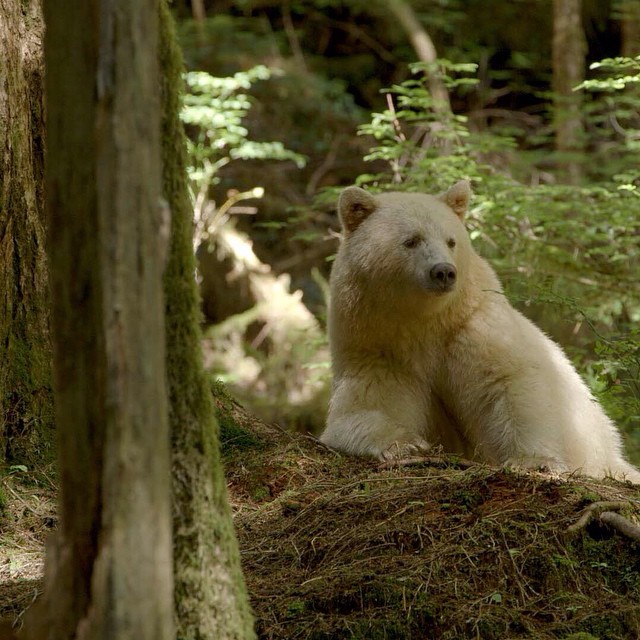
The Kermode Bear
Known as the spirit bear, the Kermode bear — a white-coated black bear — lives only in BC's central coast rainforest. The Gitga'at and Kitasoo/Xai'xais First Nations have protected this animal in their territories for centuries.

Ancient Western Red Cedar
Some western red cedar stands in BC exceed 1,000 years in age. These trees are culturally foundational to Coast Salish, Haida, and other First Nations — used for canoes, longhouses, bentwood boxes, and ceremonial regalia.
Indigenous Nations and the Pacific Coast
BC's coast is home to dozens of First Nations — Haida, Heiltsuk, Tsimshian, Nisga'a, Kwakwaka'wakw, Coast Salish, and many others. Their territories, laws, and cultural practices are embedded in the landscape in ways that extend far beyond what any map boundary reflects. Understanding the coast means understanding these nations on their own terms.
Heritage sites and cultural contextPacific Rim National Park Reserve
Established in 1970 and spanning three distinct units — Long Beach, the Broken Group Islands, and the West Coast Trail — Pacific Rim National Park Reserve on Vancouver Island protects over 511 square kilometres of coastal rainforest, sandy beach, and exposed rocky headland. The West Coast Trail, once a lifesaving route for shipwreck survivors, now draws hikers from across Canada each summer season.
Read about coastal geography
Get in Touch
Questions about a specific location, corrections to published content, or inquiries about the archive — write to us below or reach out by phone.
Explore BC's Coastal Regions
From Haida Gwaii in the north to the San Juan Islands border in the south, BC's Pacific coast contains some of the most biologically and culturally significant land in North America.
Start with coastal geography